
REAL ID
ATTENTION: Federal regulations governing the issuance of driver's licenses and identification cards have changed. Try our REAL ID Wizard to learn how these federal rules may affect you.
What is REAL ID?
On December 3, 2018, the DMV will begin offering REAL ID-compliant licenses and identification cards, which may be used for boarding a domestic flight or entering certain federal buildings or facilities. The DMV will offer these in compliance with the federal REAL ID Act of 2005, which established security standards for state-issued driver’s licenses and ID cards.
Do I need a REAL ID?
- REAL ID is an optional program.
- You don't need a REAL ID credential if you have a valid passport.
- A REAL ID credential can be used to board domestic air flights and to enter secure federal buildings after stricter federal identification requirements are initiated on May 7, 2025.
Use our REAL ID Wizard to check if getting a REAL ID credential might be right for you!
When and where do I get one?
- If you choose to obtain a REAL ID, you must complete the transaction in a DMV office.
- AAA members may also obtain a REAL ID at any of the association’s Rhode Island branch offices. For a list of AAA locations, see here.
- There is no additional cost for a REAL ID, when you apply for it during your renewal period. A REAL ID will cost $28.50 outside your renewal period.
What do I need to get one?
If you decide you want a REAL ID, you will need to get the right documents together. You must have:
- One (1) proof of identity document, such as a certified copy of a birth certificate filed with a State Office of Vital Statistics or equivalent agency (RI city or town halls) in the individual's State of birth; proof of name change, such as a government issued marriage license, required if name differs from identity document;
- AND Social Security Number (must be listed on application) or a letter issued by the Social Security Administration stating the applicant is not eligible to receive a Social Security Number
- AND two (2) proof of Rhode Island residency documents, such as a utility bill (gas, electric, telephone, cable, oil, water, sewer, satellite, heat, cell phone) with the address of residence clearly stated in the applicant’s name.
For a full list of acceptable documentation and further detail on documentation requirements, please download the following:
Para más información acerca de REAL ID, mira aquí
REAL ID Frequent Questions
The REAL ID Act was enacted by the federal government in 2005 in response to the 9/11 terror attacks. It establishes security standards for state-issued driver’s licenses and identification cards.
A REAL ID-compliant driver’s license or identification card is a credential that can be used for such activities as boarding a domestic flight or entering certain federal facilities based on the additional level of security it provides as to the identity of its holder.
Most individuals who can obtain a Rhode Island driver’s license or ID, with some exceptions.
No. The DMV does not require anyone to obtain a REAL ID-compliant credential. The choice is entirely yours.
Beginning May 7, 2025, a REAL ID-compliant credential will be required for domestic air travel and entry into certain federal facilities.
There is no need to rush to the DMV, especially if you have a valid U.S. passport. Until someone reaches their renewal time, many people may not need to decide on the REAL ID option for months or years.
No. Federal law requires that your first application for a REAL ID-compliant credential be made in person and you must bring all original required documents. After you’ve received your first REAL ID-compliant credential, you may renew online according to the standard schedule.
You must bring the required documents to the DMV or AAA (only if you’re a AAA member and a U.S. citizen) when you renew your license. You need to bring these documents with you even if you’ve had a Rhode Island license or ID for many years. These include a document to prove your identity (such as a birth certificate or passport that has not been expired or renewed within the past six months), provide proof of Social Security Number (social security number on the form, or a letter issued by the Social Security Administration stating that the applicant is not eligible to receive a Social Security Number); and two documents that prove your residency in Rhode Island (such as a mortgage statement, utility bill, property tax bill, or a current Rhode Island driver’s license or identification card).
A full list of the documents required to obtain a REAL ID-compliant credential can be found on this page.
If you were born in Rhode Island, you may obtain a birth certificate at the R.I. Department of Health and at city and town halls in this state.
For out-of-state birth certificates, we include convenient links at the bottom of this page to help you obtain your birth certificate from another state.
You must prove the change to your name with a marriage certificate, adoption decree, or other document issued by an authorized government agency.
These documents will be accepted if they are accompanied by a certified translation of the document into English.
Yes. A REAL ID-compliant credential is not required to drive any type of motor vehicle.
A REAL ID-compliant credential costs the same as a standard Rhode Island license or identification card if you obtain it within 90 days or less of your regular time of renewal. It will cost $27.50 to obtain it outside of your regular time of renewal.
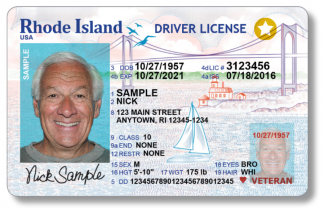
A REAL ID-compliant credential will be marked with a white star on a gold circle in the upper-right hand corner. A non-compliant driver’s license or identification card will be marked with the legend “NOT FOR FEDERAL IDENTIFICATION”.
Yes. Non-citizens can present documents such as a permanent resident card (“green card”) or an employment authorization card (work permit) to prove their identity. They must also provide their Social Security number or a proof of SSN denial AND two forms of proof of residency in Rhode Island.
You will only have to pay $27.50 if you want a REAL ID-compliant credential before your next time of renewal. If you wait until your regular time of renewal, there will be no additional charge.
- Is a valid driver’s license/ID
- Can be renewed online (every other renewal cycle) without going to the DMV
- Is NOT an acceptable form of identification to board a flight or access certain federal facilities after May 7, 2025
- Has “NOT FOR FEDERAL IDENTIFICATION” displayed on card
Yes. Your standard license can be used to drive both before and after the 2025 deadline. You will need a passport, or other document accepted by TSA, to board a domestic flight.
No. It will arrive in the mail several weeks after you apply in person. You will receive a temporary paper driver’s license or identification that indicates you applied for a REAL ID-compliant credential.
Please visit the TSA website for information regarding air travel by minors.
No. REAL ID-compliant credentials issued from another state cannot be converted into a Rhode Island REAL ID-compliant credential.
Please visit the Department of Homeland Security website for information regarding alternate forms of acceptable identification for military personnel.